US Needs More Skilled Talents and Immigration Restrictions Are Not Helping

The U.S. government interferes with the market for foreign laborers by restricting the number and mix of immigrants and setting tight quantitative limits on foreign-born guest workers. This has created a mismatch between the demand for foreign workers from U.S. businesses and their supply, directly leading to the illegal immigration situation we confront today.  — Benjamin Powell and Zachary Gochenour

This is an interesting read of the mismatch supply & demand of highly skilled labor force in the US.  Not surprisingly, there is no mention of TN visas due to the insignificant number of TN status workers.  More on that please see our previous entry.

Broken Borders – Government, Foreign-Born Workers, and the US Economy (Benjamin Powell and Zachary Gochenour)

http://www.independent.org/pdf/policy_reports/2013-09-16-powell.pdf

PDF: Broken Borders – Government, Foreign-Born Workers, and the US Economy

Spoiler/ Conclusion

There is a serious mismatch between labor demand and supply in the U.S. economy that could be alleviated by expanding the role of immigration in growing the U.S. labor force. The problem only promises to get worse in the absence of reform; the aging baby-boomer population and declining fertility rates mean that population growth in absolute terms for working-age Americans is moving toward a historic low. The need for reform has never been greater than it is now.

This study analyzed the current immigration and guest-worker quotas in the United States and found that they fail to meet domestic employers’ labor demands. The speed at which guest worker quotas are reached was given as evidence for the severe shortage, as well as reports coming directly from employers unable to meet their labor needs.

The mismatch is a systemic problem that cannot be solved by better technique: it is simply not possible for government central planners to know what the right level of immigration should be without letting decentralized market forces work.

Multinational businesses are the institutions best prepared for dealing with immigration restrictions, both practically and politically. A wide variety of visa options and work arrangements are available to corporations with offices and employees abroad, such as the L-1 visa and visas for temporary business travel. Multinational corporations are also able to hire labor overseas if they are not able to meet their labor demands with domestic labor. Small businesses are at a serious disadvantage, as they do not have the expertise, scale, or capital to overcome these challenges. Furthermore, small businesses lack seats at the political bargaining table, the availability of which would allow them to shape policy or secure favors and exceptions as large businesses are able to do.

The market for foreign workers in the United States is broken and needs reform. The current U.S. Senate proposal is a mild step in the right direction. It raises immigration caps, but leaves in place the fundamentally broken system of command and control. Red Card, an alternative guest worker proposal, is a much better solution for temporary workers because it lets market forces determine the numbers of admissible guest workers. Ultimately, the United States would be better served by moving to unrestricted migration for both guest workers and those who want permanent residency
TN info on US Citizenship & Immigration Services’ (USCIS) Site

TN NAFTA Professionals List

Typhoon Haiyan – Best Way to Help

Typhoon Haiyan will probably be recorded as one of the worst typhoon in history. The best way to help is through donations.  The Canadian government is matching donations to Canadian registered charities.

http://www.acdi-cida.gc.ca/acdi-cida/acdi-cida.nsf/eng/HEL-1110224227-6D4

http://www.cbc.ca/news/world/typhoon-haiyan-how-you-can-help-1.2423429

A list of charities and organizations posted by NBC News that are contributing to the relief efforts:

http://worldnews.nbcnews.com/_news/2013/11/11/21386694-how-to-help-organizations-offering-relief-to-typhoon-haiyan-survivors

How many TN visas were REJECTED?

In our last entry, we looked at successful issuance of TN visas (and also H1B’s).  I also came across the number of rejected TN applicants in 2012.

Drum roll please.

2012 TN Rejection Rate

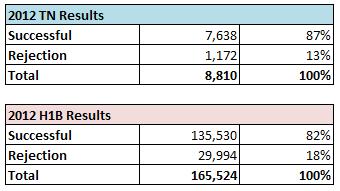
1,172 out of 8,810 of TN applications were rejected.  If I were a math teacher marking a test paper, this gets 13% rejection or 87% success rate.  Not bad.

So how does this compare to H1B?

2012 H1B Rejection Rate

29,994 out of 165,524 of H1B applications were rejected or 18% rejection rate.  Still not bad.

2012_TN_Rejection

Keep in mind though that the number of successful issuance includes renewals which has a higher chance of success.  What does this mean?  It means that if you’re thinking of applying for a TN (or H1B) visa and assuming your paper work is in order, on AVERAGE, your success rate is pretty high but not as high as 87% (or 82% for H1B).

Stats thanks to Buruau of Consular Affairs

How many TN visas were issued last year?

Given Canada and Mexico’s geographic proximity to the US and that there are no limit set on the TN visa/status issued every year, one would expect that the number of TN issued every year will be ridiculously high, right?   Well yes and no.  Here’s why.

Thanks to Bureau of Consular Affairs (CA), we were able to pull up some quick stats on TN, TD, and some other visas for 2012.

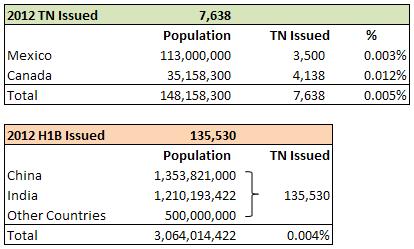
In 2012, only a whopping 7,638 TN visas were issued!  How does this compare to the more well-known work visa called H1B?  For starters, the limit set on H1B (excluding exemptions) is already at 65,000 but with renewals from prior H1B holders, the total number of H1B’s issued in 2012 was 135,530.   That is almost 20 times more than TN’s!

But wait, TN visa/status is only for Mexican and Canadian citizens so if you compare the number of issued visas to the overall country population, the percentage is actually not that far off.  Not only that, the ratio of TN issued to Canadian is 3+ times more than that of H1B visas relative the population pool of countries eligible for H1B at 0.12% versus 0,004%.

2012_TN_Issued

(The break up of number of TN issued to Canada and Mexico are approximate but total is based on Bureau of Consular Affairs.)

So what does this all mean?  Not sure because I was expecting number of TN issued to be much higher given the strong business ties with the US economy, cultural similarity (Canadians), and geographic promixity to the US.

Now that the economy is picking up, maybe this will change.

Number of Canadian MBA Grads Accepting Jobs in the US

Given that the United States is Canada’s strongest trading partner and that 80% of the Canadian population lives within 100km of the US border, it is shocking that only a small number of MBA graduates from top Canadian business schools accept positions in the US. How small? Less than 5%. Here is our theory why this is happening.

Firstly, students who enroll in top business schools typically have a few years of working experience and likely have a flavour of where they would like their next career opportunity to be geographically. If they are interested in working in the US, they will likely pursue a US school unlike a student applying for Ivey, Rotman, or Queens if she wishes to work in Toronto.

Companies and organizations close to business schools also contribute to the high local absorption rates. A common practice is for companies to indirectly outsource their hiring process to the universities who will pick the best and brightest candidates. This strategy pays off well especially when it cost a fraction of head-hunters’ rates and universities provide a constant flow of talent.

The final reason for small acceptance of US jobs is the difficulty to attain working Visa in the United States. It is difficult because of several reasons. One is that a fixed number of H1-B’s, a common foreigner working visa classification, is set and US will not issue any more once the limit is reached. The other is the financial cost that the sponsoring company burdens when hiring an employee on an H1-B visa. Due to the slump of the US economy and high unemployment rates, the cost to companies also include public image in hiring foreigners over local candidates which can have a negative impact to business.

“Canadians, especially ones with the right experience and education background, is in unique position in that they have the choice of working under a TN Visa”, claims Vance Adams, co-founder of TNVisaSample.com. They believe that the TN Visa offers a win-win solution to candidates and to potential employers given the low cost of attaining the visa and there are no limitations set. It is a temporary visa so it should not pose a threat to the US workforce.

TNVisaSample.com currently supports UBC Sauder School of Business.

“We hope that through our support there will be one less hurdle for UBC graduates entering the US work force”, Vance Adams. Will US job placements of UBC graduates increase in the US? Probably not but only time will tell.

Immigration Reform With Help From Nafta TN Visa?

Little has been discussed about a visa category that allows Canadian/Mexican professionals to work in the US. Tech startup TNVisaSample.com co-founder argues one of the simplest solutions to Immigration Reform already exists.

FOR IMMEDIATE RELEASE

TNVisaSample.com
(For Immediate Release) – Nothing divides a room full of politicians like the topic of immigration and now that immigration reform is back on the table, this month will be action packed with heated immigration debates. Not only will politicians be swinging punches, technology leaders from Silicon Valley will be out in full force arguing the importance of immigrant workers in America.

As the tech giants and political machines fight out issues over H-1B limitations or granting work visa for freshly minted graduate students, one of the most underrated topics is a working visa category called TN Status. TN Status or commonly referred to “TN Visa” is a result of a trilateral trade agreement amongst U.S., Canada, and Mexico. This visa category allows professional Canadians and Mexicans to work in the U.S. without the heavy paperwork and quotas associated to other visa classes such as the H-1B.

“We realized that the immigration system is not ideal but the TN Status is great in allowing employers to easily hire qualified Canadian or Mexican candidates,” claims Vance Adams, co-founder of TNVisaSample.com. As part of the North American Free Trade Agreement (NAFTA) signed in 1994, American, Canadian, and Mexican qualified professionals can work in each other’s countries. Although the TN visa is not permanent and lasts for 3 years, it can be renewed indefinitely and it does not require the rigorous process nor the high legal costs of an H-1B visa. If that is still not enough, there is no quota set for TN visas. Life cannot be this good.

“There is no catch at all but unfortunately this work visa classification lacks the awareness from U.S. companies”, explained Adams, who started his U.S. career on a TN visa before launching TNVisaSample.com. “Not only does it help in recruiting for roles that are difficult to fill, it also retains graduates from American colleges who otherwise would be force to return to their home country.”